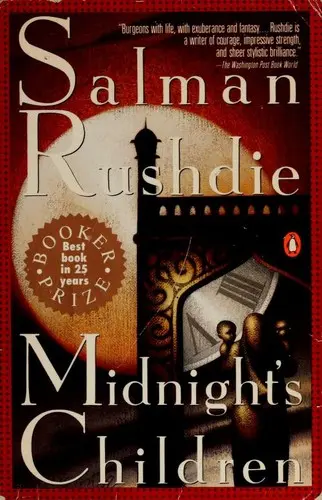
Midnight's Children
Decide its fate
The record
Time
An eveningA season580 pages, about 12 hours: the length of 1.8 typical books on the shelf.
Getting in
Walk right inSteep climbThree readers report struggling to start the book, two independently stalling by chapter three.
One of a kind
Others do thisNothing else doesA Mumsnet reader recommends A Fine Balance, on the shelf at 719 pages, as the South Asian novel that has it all.
The case for it
on Saleem’s nose
“Saleem’s particular gift is a ‘cucumber’ of a nose with which he goes through life”
Kirkus Reviews, 1981 on the perforated sheet
“The Perforated Sheet is one of the more profound images I’ve ever read.”
a book blog on Saleem’s voice
“the garrulous voice fits so well with Saleem’s personality”
a book blog on the wit and humour
“draws you in with its wit and its humour which flows through the narration”
a book blog
The case against
on the treatment of women
“too much crass sexualisation, and careless violence towards women”
three stars · a book blog on chapter three
“struggling to read a chapter a day by the end of chapter 3”
a book blog on the midnight children
“too many kids, too many ideas, too poorly organized”
a book blog on the writing style
“all I’m reading is self-indulgence and verbosity”
a Mumsnet reader