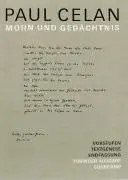
Poppy and Memory (Mohn und Gedächtnis)
Celan was a Romanian Jew whose parents died in Nazi death camps; he survived and wrote in German, the language of the murderers. "Death Fugue," the collection's centerpiece, is the defining poem of the Holocaust: "Black milk of daybreak we drink it at evening." Its fugue structure (repeating, inverting, building) enacts what it describes. Celan's impossibility, writing in German about what German had done, became his subject and his torment. He drowned in the Seine in 1970.
Three different English editions compete for this book and each gives a different Celan: Pierre Joris's complete bilingual Memory Rose into Threshold Speech, Michael Hamburger's long-running Poems of Paul Celan, or John Felstiner's Selected Poems and Prose. At least one comparison judges Joris weaker on these early poems than the older versions, calling Hamburger “usually the more dependable” while granting Felstiner is “witty and lyrical” but less exact. That leaves a reader chasing the best English Celan without a clean answer, just tradeoffs between translators. Even sympathetic critics warn that Celan's poetry, the later work especially, reads as “strikingly difficult, even obscure,” which should temper any hope that this earliest major collection goes down easy.
The case for it and the rest of the canon open with Pro.