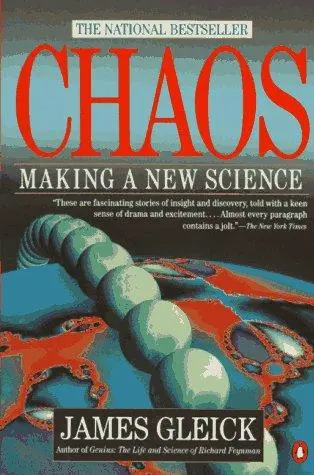
Chaos: Making a New Science
Gleick brought chaos theory (the butterfly effect, fractal geometry, nonlinear dynamics) to a general audience with the clarity of a great teacher and the excitement of a discovery narrative. It made mathematicians and physicists into celebrities and gave everyone a new way to think about complexity and unpredictability.
Gleick banished the equations and replaced them with personalities: chain-smoking Feigenbaum, maverick Mandelbrot, every scientist a lone cowboy ignored by the establishment. The hero narrative flatters its subjects (Mandelbrot's self-mythology gets through unchecked), women barely appear, and the promised revolution, supposedly on par with relativity, settled into one useful toolkit among several. The 1987 frontier reads as history now.
The case for it and the rest of the canon open with Pro.